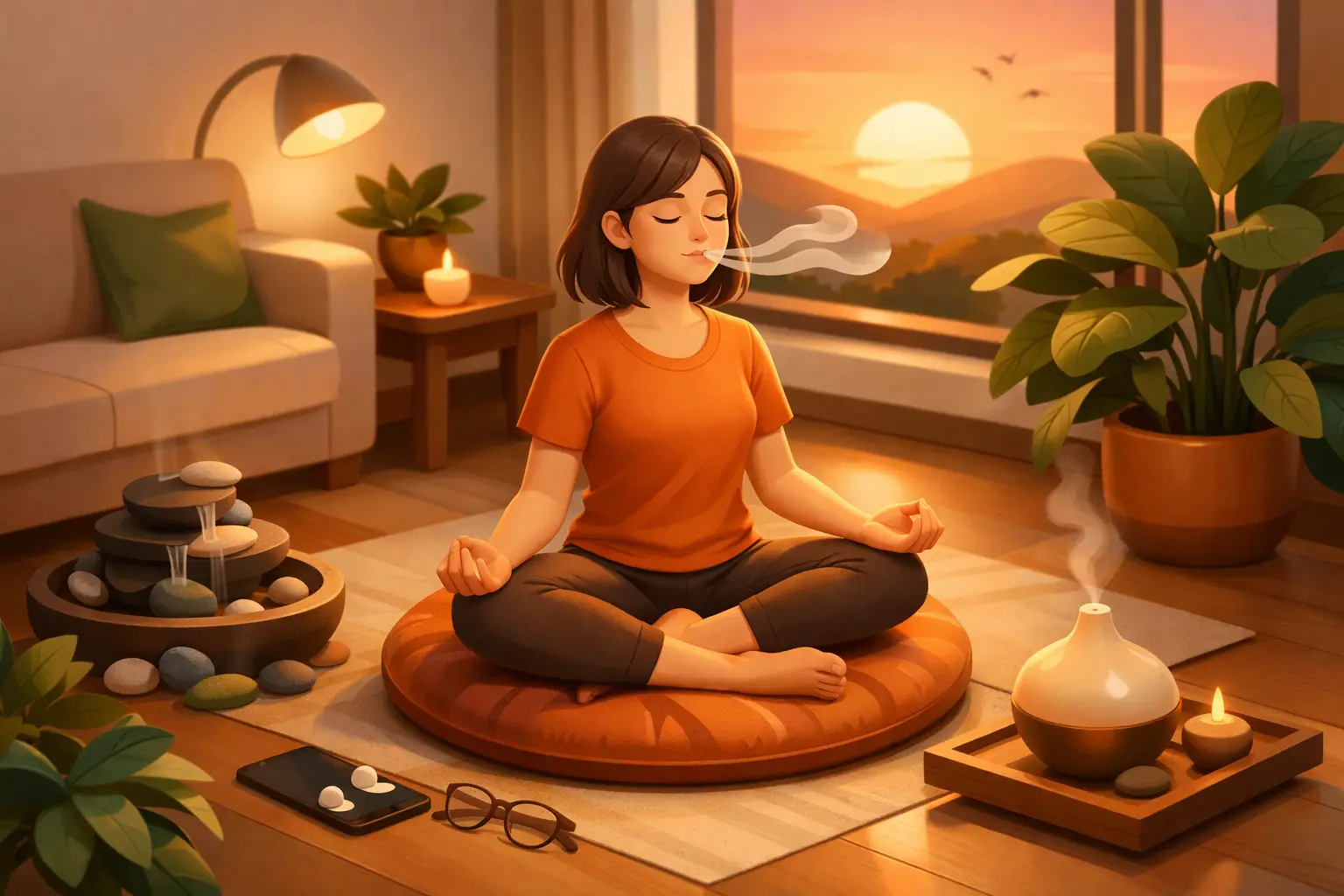
Your body may still be carrying the meeting that ended hours ago, the traffic, the difficult conversation, or the dozen small moments that asked too much of you. A breathing exercise after stressful day tension can create a gentle pause between what happened and what you carry into the rest of your evening.
You do not need to force yourself into calm or pretend the day did not affect you. Breathwork offers a place to meet yourself honestly. With each intentional breath, you can begin to soften the tightness in your chest, notice what is present, and make room for release.
Why stress can stay with you after work
Stress is not always something you can leave at your desk or outside your front door. Even when a demanding situation is over, your body may remain alert. You might feel restless but exhausted, unusually impatient, disconnected from the people you love, or unable to focus on anything relaxing.
That lingering feeling is not a personal failure. It is often your system asking for a transition. A few conscious minutes of breathing can signal that the urgency has passed and that you are safe enough to come back to the present moment.
Breathwork is not about achieving a perfect state of peace. Some days, you may feel calm quickly. On other days, you may notice sadness, frustration, or tears first. All of those experiences can be part of release. The goal is not to perform relaxation. It is to offer yourself space to feel, breathe, and reconnect.
A simple breathing exercise after a stressful day
Set aside five to ten minutes in a place where you can sit or lie down comfortably. You do not need candles, special clothing, or a completely silent home. You only need a little willingness to be with yourself.
Begin by placing one hand over your heart and the other over your belly. Let your shoulders drop without pushing them down. Notice the natural rhythm of your breath before trying to change anything.
Then try this steady pattern: inhale through your nose for a count of four, exhale gently through your mouth for a count of six. Continue at a pace that feels comfortable for you. The longer exhale is an invitation to soften, not a rule you need to get right.
As you breathe, quietly ask yourself: What am I still holding from today? You may not receive a clear answer. You may simply notice a clenched jaw, a busy mind, or a heaviness in your chest. Let that awareness be enough.
Stay with the practice for several rounds. If counting makes you feel more tense, release the numbers and simply allow your exhale to be a little slower and fuller than your inhale. Your breath does not need to be dramatic to be meaningful.
Give the exhale a place to land
Many people move through stressful days by holding their breath without realizing it. They answer one more message, solve one more problem, and keep going. By evening, the body has learned to stay braced.
A fuller exhale can be a compassionate interruption to that pattern. Imagine that every exhale gives the day somewhere to go. You are not erasing what happened or avoiding what needs attention tomorrow. You are choosing not to carry every unfinished feeling into your night.
If it feels supportive, make a soft sigh as you exhale. Sound can help the body release some of the pressure it has been quietly holding. Keep the sound natural and low. There is no need to push air out or create intensity.
You might repeat a simple phrase with your breath: “I can let this moment be complete.” Inhale gently. Exhale and repeat the phrase internally. Words are optional, but they can offer a steady point of connection when your thoughts are racing.
When emotions come up, let them be information
A quiet breathing practice can sometimes bring forward feelings you were too busy to notice earlier. Irritation may reveal disappointment. Numbness may sit beside grief. A stressful day can also touch older experiences that have nothing to do with the email, commute, or conversation that set you off.
You do not have to analyze every emotion while you are breathing. Try naming what is present with kindness: anger is here, worry is here, sadness is here. Naming an emotion can help you relate to it without becoming consumed by it.
If strong feelings arise, slow the practice down. Return to a natural breath, open your eyes, look around the room, and feel your feet against the floor. You are always in charge of your experience. Breathwork can be powerful, and gentleness is part of that power.
For those navigating trauma, panic, or intense anxiety, a more activating breath practice may not feel supportive when done alone. A slower, grounded approach is often a better place to begin. Personalized guidance can provide a safer container for exploring what your body and emotions are ready to release.
Turn the practice into an evening transition
The most helpful breathing exercise is often the one you will actually return to. Rather than waiting until you are completely overwhelmed, pair your practice with a familiar part of your evening. Try it after you park the car, before you make dinner, after changing out of work clothes, or just before bed.
Consistency does not mean doing it perfectly every night. It means building a relationship with yourself that says, “I will check in.” Some evenings may allow ten quiet minutes. Others may only offer three breaths beside the sink. Both count.
After you finish, resist the urge to immediately pick up your phone or return to another task. Sit for a moment and notice even the smallest shift. Maybe your jaw has softened. Maybe your thoughts are still there, but they feel less urgent. Maybe nothing has changed yet, except that you gave yourself care. That matters.
You can also place one hand over your heart and one over your belly again, then ask: What do I need now? The answer may be water, food, rest, a boundary, a conversation, or simply permission to do less. Breath creates the pause where that honest answer can be heard.
Let breath become a practice of inner love
Stress often teaches us to override ourselves. We keep moving even when our body asks for rest, minimize our emotions, and treat self-care as something to earn after everything is done. A few minutes of conscious breathing is a different choice. It is a way of remembering that your inner experience deserves your attention now, not only when you reach a breaking point.
At Empowered Breathwork, guided sessions create room for this kind of awareness, release, and reconnection in a supportive community. Yet your breath is also available in the ordinary moments: after a long day, before a difficult conversation, or when you need to return to yourself.
Tonight, you do not need to solve every stressor before you rest. Let one slow inhale remind you that you are here. Let one unhurried exhale remind you that you can put down a little of what was never meant to be carried alone.